Friday, February 12, 2016

Can't Fight The Feeling: A Cynic's Valentine Flick List

Valentine's Day is almost here, and I thought that despite my usual disdain for the holiday, I could admit to having a few more romantic movie favorites (see previous post for the Black History Month edition). This is not a complete list, just more that came to mind.

1. Love Actually (2003)

Those who know my aversion to lovey-dovey film pablum may be surprised by my affection for this one. Somehow the film's anthology of romantic kerfuffles is improved by its British accent. A fat valentine of a movie, Love Actually weaves together several plotlines to demonstrate that love of all kinds is truly all around us. It zeroes in on guests at the wedding of Juliet (Keira Knightley) & Peter (Chiwetel Ejiofor), including four siblings: Emma Thompson, a stay-at-home mom who finds evidence that her ad exec husband, played by the late Alan Rickman, is having an affair with his sexy secretary, while his office mate, American Laura Linney, puts love with the art director on the back burner to care for her
mentally ill sibling; brother Hugh Grant, England's newly elected bachelor prime minister, finds himself attracted to his bubbly new household manager; brother Liam Neeson, still grieving his wife's death, helps his young stepson capture the heart of an American classmate and re-ignites his joie de vivre; brother Colin Firth, after discovering his girlfriend cheating, decamps to Provence to write his next book and falls for the Portuguese housekeeper who speaks no English.
Dad: Aren't you a little young to fall in love? (Hee hee hee...) Son: No. (Dummy.)

Meanwhile, a couple of young actor body doubles (including The Hobbit's Martin Freeman) meet on-set while simulating a graphic sex scene and proceed to have a conventional romance; a loveless dork heads to America with unrealistic dreams of finding sexual fulfillment abroad that miraculously come true the moment he lands; new bride Juliet (Knightley) is perplexed by the unfriendly behavior of her groom's best man until he reveals his own love for her; and an aging rock star on the comeback trail, played to the raucous hilt by Bill Nighy, realizes that his favorite person in the world is actually his long-suffering manager.

It's a sweet, comical, yet thoughtful film with numerous "that would never happen in real life" moments of coincidence, melodrama and wishful thinking, but somehow the film floats on a sea of its own charm and conviction. And there are some serious moments delivered expertly by the top-notch cast, with tear-inducing performances by the heartsick Thompson, the conflicted Rickman, the lovelorn Linney, and by young Thomas Sangster as Neeson's son. Being British, the script can't help but take swipes at arrogant, entitled America through scenes with Billy Bob Thornton as a sneering U.S. President, but Americans will just have to let the medicine go down amid all the sugar. Set at Christmastime with gorgeous shots of a wintry, holiday-spangled London, Love, Actually has become one of my faves for holiday viewing as well.

2. The Bridges of Madison County
(1995)

I am ashamed of myself for this one, but if I see it anywhere on cable, I have to watch to the bitter end. It was a ridiculously sappy, self-indulgent book, and the film would be a snore-worthy slog if not for one thing: Meryl Streep's performance. She plays an Italian war bride in 1965 whose husband and teen children go to the Iowa state fair for a week, leaving her blissfully alone. By chance she meets a recently arrived National Geographic photographer, played by Clint Eastwood, assigned to shoot the local covered bridges. Fascinated by his freewheeling lifestyle and expansive philosophy, sheltered Francesca can't help but fall in love. After a whirlwind affair of evening walks, candlelit dinners, dancing, and lovemaking, Francesca must make a heart-rending decision: leave for a nomadic life of passion with Robert Kincaid, or stay on the farm for a life of duty with the husband and children who need her.

Eastwood is a bit wooden in this role, but perhaps he wasn't as concerned with acting as he was busy directing this lushly photographed, beautifully staged drama featuring an evocative soundtrack of composed music and classic jazz gems (the Johnny Hartman tunes alone are swoon-worthy). It's Meryl Streep's movie, and the Queen of All Accents gets it exactly right. With her hair dyed dark, aproned and barefooted, utilizing European hand gestures, faded Italian accent in place, Streep gives us a woman stoically living with decisions made a long time before with no expectation of change. The dialog doesn't delve into her character's background, but during World War II, living in a country occupied by the U.S. army, Francesca married an
American serviceman in exchange for what she believed would be a better life. She left her home, family, friends, and everything she knew to live in a brand new land to learn a new language and new customs, adjust to marriage to a foreign man, bear his children and work his farm. She was likely resigned to this life, and may have thrived in it, until boom! A beautiful stranger lands on the doorstep reeking of romance and excitement. All of this information lives within Streep's calibrated portrayal, which owes more than a bit to the mannerisms of Italian actress Anna Magnani, a towering inferno of '50s-'60s screen acting (see Wild Is The Wind, The Fugitive Kind, or The Rose Tattoo).

The moment I wait to see is when Francesca has packed a bag but still can't take the final step out the door. She clutches Robert in desperation and says, "You must decide for me." Well, she realizes that leaving would be folly and stays. But the next riveting moment comes in town when grocery shopping with her husband, and she sees Robert's truck about to leave forever. The pouring rain stands in for a torrent of inward tears -- hers and ours -- as Francesca has one last inward struggle. Still, she can't leave. But when Robert hangs the silver saint's medal she gave him from his rearview mirror before driving off, Francesca and the audience know that their love will never be forgotten.

The film has a framing device involving her grown children discovering the affair after her death that could easily have been jettisoned, and for some the movie is too long and slow. But for me, this leisurely stroll under the sun of an Iowa summer watching Meryl and Clint is sweet, indeed.

3. Moonrise Kingdom (2013)
And they called it puppy love, just because we're in our teens ...

I grew up fascinated by fairy tales, with their images of enchanted lands, mythological beings, and the impossible made possible through a glorious quest. Having once been a precocious, independent kid, I'm still partial to stories about precocious, independent kids. Thus my nostalgic fondness for Wes Anderson films: the highly stylized children's storybook sets, costumes, makeup, and shot framing; serious, quirky, wise-beyond-their-years youngsters facing off against ridiculous, childlike adults; and the whimsical, episodic adventures to attain love or liberty (Rushmore, The Royal Tenenbaums, The Fantastic Mr. Fox, The Grand Budapest Hotel). Moonrise Kingdom has all of these things. It's a coming of age love story along the lines of the delightful 1979 gem A Little Romance (in which 13-year-old Diane Lane falls in love and runs away from Paris with the 13-year-old son of a French taxi driver to kiss under the Bridge of Sighs in Venice), albeit with a serio-comic tone. Set in a 1965 that is worlds away from The Bridges Of Madison County, the film is like flipping through an album of faded Kodak vacation prints -- all smudged blues, browns, and greens, filmy corals and soft whites. The story concerns a smart but friendless orphan named Sam who meets Suzy, an introverted bookworm, at the annual summer pageant on the fictitious New England island of New Penzance.

After months of exchanging letters, the 12-year-olds meet the following summer on the island and run off together. The disappearance of the youngsters alarms the island's sherriff, played by Bruce Willis, as well as Sam's tightlipped social worker Tilda Swinton, his by-the-book scoutmaster Edward Norton, and his hooligan fellow scouts, not to mention Suzy's self-absorbed lawyer parents, played by Frances McDormand (who's been having an affair with the Willis character) and Anderson habitue Bill Murray. Sam, an expert outdoor survivalist, and Suzy, armed with sewing scissors, manage to evade a group of scouts and their dog after a violent run-in.
The eccentric pubescents then have a few idyllic days sharing first kisses, cavorting in their undies, and spooning in a tent by a lagoon in perfect domestic and spiritual harmony before they are discovered and pulled apart by the adults. But it isn't long before Sam escapes his scoutmaster to rescue Suzy and seal their love with a symbolic marriage ceremony performed by a supportive scout captain (Jason Schwartzman) just before a hurricane strikes the island, foiling their getaway plan.
The core of the film is the natural, earnest performances Anderson elicits from young actors Kayra Hayward and Jared Gilman; while the action around them grows increasingly cartoonish and frenetic, the film never mocks nor questions the veracity of Sam and Suzy's feelings, despite their tender age. And neither do Sam and Suzy engage in sugary sentiments or cute banter; they simply interact as kindred spirits who commit their entire beings to each other, come what may. In the end, all of the adults -- including the audience -- are forced to accept Sam and Suzy's forever love as an incontrovertible fact. Director Anderson's style has been criticized as too precious or "twee," but it's still an enchanting and deeply romantic romp.

Honorary mentions to:
1. About Last Night (the 1986 Demi Moore/Rob Lowe original)
2. The Getaway (the 1972 Ali McGraw/Steve McQueen love-on-the-run original)
3. Dr. Zhivago (1965 Russian Revolution-set epic with Julie Christie & Omar Sharif)
4. Annie Hall (1977 Woody Allen & Diane Keaton classic)
5. Out Of Sight (1993 crime caper with heat from Jennifer Lopez & George Clooney)
6. An Officer & A Gentleman (1982, Debra Winger/Richard Gere)
7. Roxanne (yes, the 1987 Steve Martin/Daryl Hannah comedy is highly romantic)
8. True Romance (1993, Tarantino's love-on-the-run fantasia with Patricia Arquette & Christian Slater)

Wednesday, February 10, 2016

Valentine's Viewing: Black History Month Edition

I have conflicting emotions regarding the holiday named for St. Valentine. A former boyfriend from my teenage years once remarked, "You know what you are? A romantic cynic." And that about sums up my attitude.

I reject as a matter of course the syrup-sodden, pink and red, cutesy-poo Cupidfest that has subsumed our national tribute to romantic love. During times without a significant other, the holiday makes a mockery of my singlehood. Still, even if I am "boo'ed up," I'm flummoxed by the Valentine's thing; the challenge is in how to mark the occasion at a level appropriate to where the relationship stands -- without tumbling over the Cliffs of Sentimentality into a hot cloying pool of Kissy Kitsch. My gag response is too easily triggered.

But underneath my crusty exterior, I'm a softie. A bouquet of posies from that certain someone acknowledging whatever warmth lies between us can definitely melt away this cynical exterior. A cleverly worded missive -- rarely found in the annals of Hallmark -- can make me smile. I too have launched a few of the heart-shaped cards at moving targets over a few Februarys. But my general policy is to carry on as though these public displays aren't necessary or even that practical.

I suffer from a similar gag response when it comes to romantic movies. Anything too stuffed with corn, dipped in schmaltz, or shot through with formulaic sugar is generally to be avoided. So my list of favorite romantic flicks is short. But I'm only human, so there are other films -- corny, schmaltzy, predictable and dripping in Hollywood cliche goo -- that still get under my skin. I'll address those in another post.

Being that February is Black History Month, I thought I'd name a few black romance classics appropriate for Valentine's Day viewing.

(Note: While I enjoyed The Best Man films, Why Did I Get Married, Just Wright, Love And Basketball, Brown Sugar, the About Last Night remake, Jumping The Broom, Something New, and the like, I wouldn't call them classics. At least, not yet.)

1. Love Jones(1997)

Nia Long and Larenz Tate get into a little sumthin' sumthin'

I don't think I've seen a movie before or since that captures contemporary black love in quite such an affecting way. Artsy young Chicago professionals Nina Mosley and Darius Lovejoy -- as played by Nia Long and Larenz Tate -- are great to look at and their chemistry is tangible. In their love scenes, you can feel the yearning, the sizzle, and the lust. The story allows us to see how their romance unfolds through events that we recognize -- the spoken word club, the friend's house party, the badly timed lingering exes, going dancing. It's the dialogue and inclusion of so much of African American culture sets the film apart. Much in the way that another Chicago-set romance that I'm fond of -- 1986's About Last Night with Rob Lowe and Demi Moore -- examines 20something love from every angle and includes a Greek chorus of negativity from those who would break up the lovers for their own selfish reasons, so do Nina and Darius face embittered people and setbacks that almost convince them that love "ain't shit." Doubt, distrust, jealousy, insecurity, missed signals, denial -- it's all there, set to a fantastic, evocative soundtrack melding alternative R&B and classic jazz. In the end, Darius realizes that that elusive joy that you create with that one special person is too precious to throw away, and we know that somehow Nina and Darius are going to work it out even as she leaves on the evening train for New York. Notable for great performances by Lisa Nicole Carson and Isaiah Washington as the respective best friends. Hard to believe the film is almost 20 years old.

2. Claudine (1973)

Diahann Carroll and James Earl Jones get that lovin' feelin'

Some would say that this film represents another kind of '70s blaxploitation, in that it exploits the trope of a black single mother on welfare in the hood who is cheating the system with a maid's job. But I don't care -- Claudine is a gem because it gets real. Hard to believe that movie makers at the time thought Diahann Carroll was a little too glamorous to carry off the title role, but Diahann -- who was raised in Harlem -- hits all the necessary notes as a mother of five who finds herself falling against her better judgment for a garbage man with a raft of problems of his own. Far from the Romeo & Juliet drama of young Harlem lovers like those portrayed by Kevin Hooks and Irene Cara in 1975's Aaron Loves Angela, directed by Gordon Parks Jr., Carroll's Claudine and James Earl Jones' Rupe are hampered by grown folks' problems: troubled and rebellious children, the grind of menial gigs, roach infested dwellings, and the government interference that poor people are sadly all too familiar with -- welfare in Claudine's case and child support in Rupe's. To consider marriage under these conditions would be to throw away everything Claudine has known, including the monthly welfare checks she depends on, and she isn't sure that Rupe will stand by her. But in the end, it's Carroll and Jones making eyes at each other and trying to make an unworkable situation work that convinces you that their love is worth the risk. Black love wins out -- neither the social worker nor the police will stop these two. Curtis Mayfield's soulful and thoughtful score, performed by Gladys Knight & the Pips, adds to the emotion of the film by voicing the thoughts of the characters. "Keep Away From Me, Mr. Welfare," "To Be Invisible," "The Makings Of You," and "Make Yours A Happy Home" are timeless classics.

3. Boomerang (1992)

Eddie Murphy as Marcus: What more would a woman need?

Not a typical romance, Boomerang is a clever, slickly-produced comedy about how complicated the road to love has become in the modern era. Directed by Reggie Hudlin, produced by brother Warrington Hudlin and stuffed with a who's who of African American talent -- Eddie Murphy, Robin Givens, Halle Berry, Eartha Kitt, Chris Rock, Geoffrey Holder, Grace Jones, Martin Lawrence, David Alan Grier, Tisha Campbell, Lela Rochon, John Witherspoon and Melvin Van Peebles -- this is the tale of a notorious Big Apple ladies' man who finally finds the girl who makes him hang up his playboy dancing shoes. The film is a testament to '90s upward mobility as the upscale characters explore dating, racism, the wages of celebrity, and the bonds of male friendship as Eddie Murphy's bad boy ad exec, Marcus, finally learns that it's no fun being on the receiving end of the deceptive seductions he's been doling out to most of the females at the ad agency where he works.
Robin Givens as Jacqueline: "God, Marcus. I was so tense when I got off the plane, but you really relaxed me. See ya."

Robin Givens is perfect as the conniving career woman determined to break Marcus down (I think her next best screen role was as Imabelle in A Rage In Harlem, a tour de force performance in which she is utterly convincing as a 1950s gold-stealing femme fatale who ultimately falls in love with the mild-mannered funeral home assistant played by Forest Whitaker). Eddie Murphy also gives the film some great quieter moments, as in his scenes with Berry and in chopping it up on the issues with his friends. There's a streak of feminism to the film in the way that Givens' Jacqueline and Halle Berry's Angela -- and though played for laughs. even Grace Jones' extreme character Strangé and Eartha Kitt's cosmetics company head Lady Heloise -- are all committed to owning their careers and their sexuality, albeit in very different ways, in a male- dominated world. The sets, costume designs, makeup and smooth soundtrack by Marcus Miller combine to give the flick a shiny immediacy, while the ace performers offer up countless golden moments of comedy that have become oft-repeated classics (some only need one word: "Marrrrrr-cus!" "Coooor-dinate!" "Strang-e!") While Marcus ultimately walks off into the Brooklyn sunset with the Halle Berry character, having professed his love, we're only 99 percent convinced that love really will bring him home the next time he's tempted.

4. For Love Of Ivy (1968)

Abbey Lincoln as Ivy: Ma'am, what part of "I'm leaving" did you not understand?

This romantic comedy is more than a bit dated, but it was a breakthrough coming just four years after the passage of the Civil Rights Act. A black romance that white people could accept, the lighthearted yarn centers on another maid, this time played by stunning vocalist Abbey Lincoln in one of her few screen turns, while the usually upright Sidney Poitier -- just past his Black Saint period in film -- plays a character with a couple of skeletons in his closet. Ivy Moore is the beautiful, dutiful and smart 20something live-in housekeeper for a Long Island businessman played by All In The Family's Carroll O'Connor and his family, including their "hip" 20something son, played by Beau Bridges. (Two years later, Bridges would portray the "hip" son of a rich New York family who buys a Brooklyn brownstone and embeds himself among his black tenants to disastrous results in the simultaneously hilarious and sobering film The Landlord, which also featured the late, great Diana Sands. He has also played the father of Tracee Ellis Ross' Rainbow character in an episode of TV's Blackish.) When Ivy decides that after nine years she's had enough of the maid game and plans to leave to attend secretarial school in New York, the family is sent into a tizzy, because, naturally, they consider her "family" and immediately plot ways to dissuade her. Despite this being a brazen attempt by whites to stop a black woman from liberating herself from servitude or gaining agency over her own future, their meddling is depicted as sweet, loving and in her own best interest. Beau's character decides that what Ivy needs is a suitor who will distract her but not whisk her off. Because, what else would keep a black woman from pursuing her dreams but a man? And a trifling one at that? The son blackmails playboy trucking magnate Jack Parks -- because he may be shady but he's black! -- who reluctantly agrees to take Ivy out on a date.
They go but she's a sheltered Southern girl and he's a smooth big city slickster secretly running an illegal casino operation out of the back of his trucks, and it doesn't seem that things will work out. Still, Jack is captivated by Ivy's simple directness, modesty and beauty. For the love of Ivy, Jack is willing to give up his double life. And just in time: In order to take Ivy away with him to New York, Jack hands over the operation of the casino to a pal and is no longer connected when the casino is busted by the police. What saves the movie from complete corniness is the chemistry between Lincoln and Poitier; Lincoln's character may be sheltered, but she knows exactly who she is. While I love Abbey Lincoln's realness, she doesn't have the same easy comic timing as the rest of the performers so that makes the tone a bit uneven, but it's still a cream puff of a flick about black romance during the swinging '60s.

5. Black Orpheus (1959)

First time actors: Brazilian Breno Mello and American Marpessa Dawn the morning after

I cannot say enough about the total magic of this film, which earned the Oscar for Best Foreign Film in 1960. Shot entirely in the favela of Morro de Babilhonia and the city of Rio de Janeiro, the film adapts the Greek myth of Orpheus and Eurydice to then-modern times. Combining the beauty of the Afro-Brazilian people, the traditions and music of Brazil, and a tragic and timeless love story, Black Orpheus is a delight to the senses. Beautiful Eurydice arrives by boat in Rio, where residents are busy preparing for Carnaval. On the streetcar she meets the conductor, Orfeu, a fledgling musician who has reluctantly committed to marry his outgoing girlfriend Mira. Orfeu guides Eurydice up the hill to the favela where she will stay with her cousin, who is awaiting the return of her sailor boyfriend.
But Eurydice has a secret -- she left home to escape a specter in a death mask who is trying to kill her for reasons that are never revealed. Soon enough, Orfeu and Eurydice fall in love. They head to Carnaval to dance in the samba school competition in their costumes, trying to hide from both a jealous Mira and Death, who has appeared to claim Eurydice's life. When tragedy befalls his beloved, Orfeu -- still clad in his sexy sun god Carnaval gear -- embarks on a physical and spiritual journey across the city to reclaim her. What could be more romantic? Alas, the myth ends tragically. But when three small children greet the sunrise with music and dancing, hope springs eternal. And the music throughout -- by national treasures Luis Banfa and Antonio Carlos Jobim -- is sublime, as the soundtrack includes carnaval sambas, bossa nova, candomblé ritual music, and ballads. The film has detractors who say that it is French director Marcel Camus' attempt to exoticize people of color and romanticize their poverty and dysfunction (much in the same way that George Gershwin's Porgy & Bess, another classic black love story, has been reviled for being a white New Yorker's version of Southern black life, "Negro" dialect and all). Some viewers may be put off by subtitles, while others may be confused by the story's many moments of magical realism owing to its mythological roots. Watch anyway.

Honorable hearts & flowers mentions to:
- 2014's Beyond The Lights, reviewed here
- 1960's Carmen Jones, where Dorothy Dandridge and Harry Belafonte make beautiful operatic music together until murder gets in the way
- 1994's Jason's Lyric, where Allen Payne and Jada Pinkett Smith struggle to get out from - under family and gangland trauma in Houston to make a way together
- and 1972's Sounder, where Cicely Tyson's devotion to sharecropper husband Paul Winfield is palpable.

Tuesday, September 22, 2015

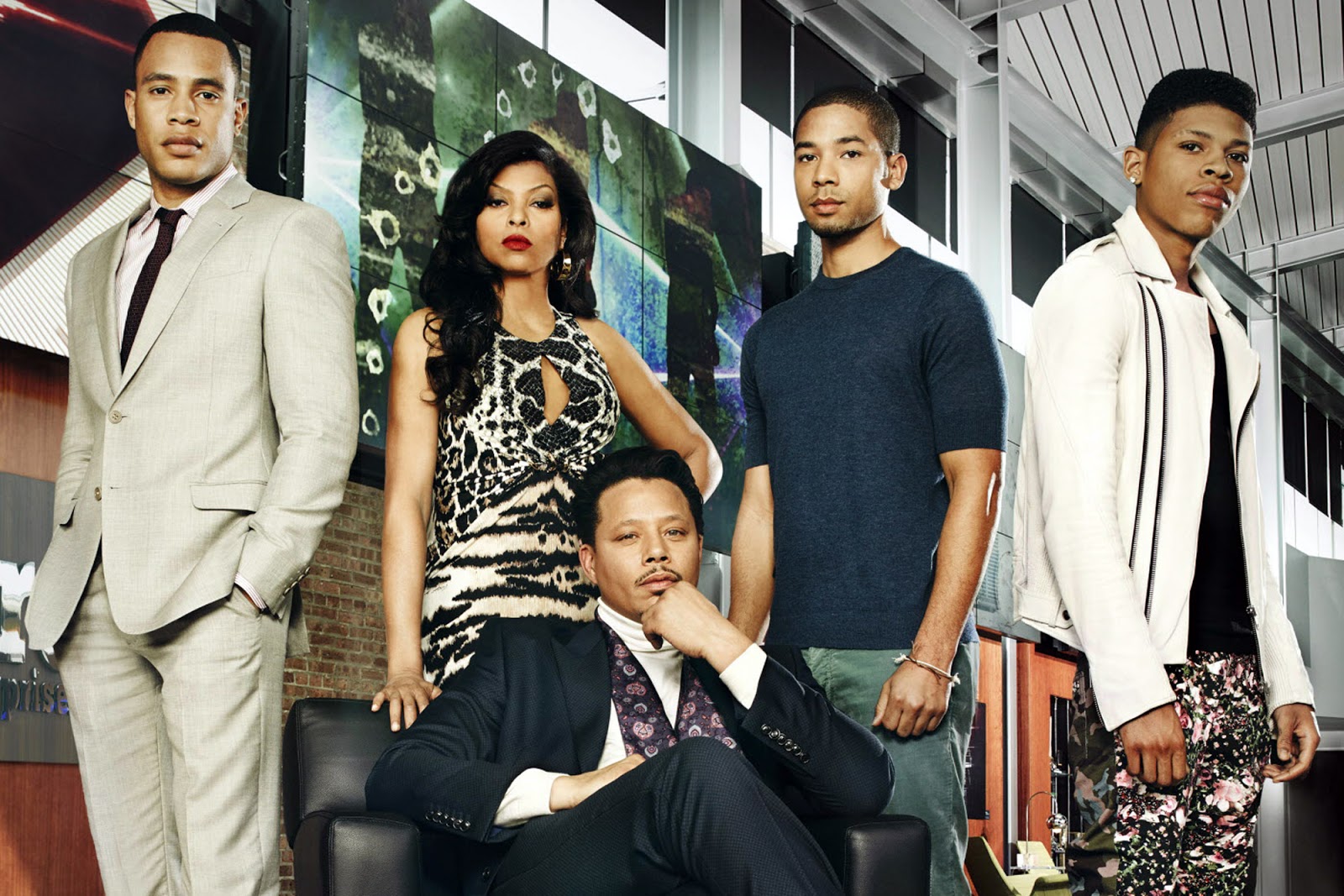
Reasons To Watch "Empire"


I started this during the first season. Seems appropriate to post now, before Season 2 kicks off.


On the Eve of Season 2: Reasons To Watch "Empire"

I became a fan of the Lee Daniels-created show Empire after only a brief internal struggle. Whereas I was hesitant to declare myself a fan at first, I am now firmly in the show’s corner despite a good deal of backlash from many African Americans who say the show’s value systems, depictions of people of color, and flair for ratchet drama are profoundly detrimental to how African Americans are perceived in this country. My first instinct upon viewing Empire was to throw up my hands and cry Lawd-a-mercy! This is airing our dirty laundry! This is just low class! This is culturally destructive! And the music’s bad!

But I couldn’t. And now I won’t.

When I turn on the television at the end of a long day, I want to be entertained. I don’t think every show on television has to represent a paragon of cultural virtue, and I’m tired of black folks bearing the brunt of the need to be politically correct all the damned time. Empire is a fast-paced, of-the-moment, let-it-all-hang-out soap opera fantasia in living color, and to me – someone proudly born and raised in the South Bronx who spent many years as a moth around the flame on the music business – it shines a light on some truths about the black experience while also shining a light into some dark corners that haven't been explored on TV. It does some things production-wise that are entirely sharp. The show often feels like who we are: fast, messy, honest, political, funny, rude, angry, conflicted, warm and lusty. It offers up the variety of black experience – because we are not a monolith – and does so with a neck-snapping intensity and dizzying pace.

Yes, Empire’s record company business tactics and politics are way over the top. And yes, some of the characters and caricatures are extreme. But in the music business, the drive to make top-selling hits, to nurture the impulse to create, to best one’s competitors on the charts, and to maintain the momentum of one’s musical career -- all of this is entirely real. And many of the personalities that drive the industry game ARE extreme.

Yes, Empire shows eye-rolling, neck-snapping black women and angry, occasionally violent black men. It approaches cartoonishness in plot development and caricature. It shows drug dealing and crime as a path to business success. Empire shows sex in a multiplicity of permutations: cheaters and kinky marrieds, cougars and cubs, lesbians and gays, black and white. It’s sex, drugs and hip-hop.

But that is not ALL it is. It is more.

Empire also offers up a wealth of other issues, realities, and portrayals seldom seen elsewhere on the small screen, and it is done with a level of spectacle that to my mind, tops even Dynasty. Here are a some issues of note raised during the show's first season:

• It’s about an African American family headed by a strong black male (Terence Howard, and let's leave his headlining personal life aside). OK, he’s a murdering, duplicitous, manipulative thug -- but a musically talented one trying to leave a legacy for his sons so they won’t have to be the thug he is.

• The male siblings love one another no matter what – even when their father pits them against each other. One of the things I like about the storyline is that although Lucious keeps setting them on a collision course and despite their different sexual orientation, Hakeem (Bryshere Y. Gray) and Jamal (Jussie Smollett) are better artists when they make music together, and they know it. And the two youngest respect what Andre (Trai Byer) brings to the table and try to hold him together when he is falling apart.

• There was a depiction of a family within the Nation Of Islam. Remember when Cookie (Emmy-nominated Taraji P. Henson) went to speak with the mother of one of the label’s prospective rappers who was raised in The Nation? When do we ever hear “Muslim” mentioned in a TV narrative and it does not refer to terrorism or someone with roots in the Middle East? There is an American Muslim community firmly established here.

• Cookie’s experience in prison spotlights the rising incarceration rate of African American women in the U.S. and the profound impact of their absence on families.

• Jamal’s personal journey sheds light on the homophobia that is fracturing many African American families and turning many young people into virtual orphans with no familial support. Jamal is fortunate to have an established music career that earns him money to pay rent somewhere.

• May-December romances. Remember Hakeem working out his mommy issues with Naomi Campbell's character? The phenomenon of the “cougar” as it is impolitely referred to has long been in play. (Remember Marvin Gaye's first marriage to Berry Gordy's sister Anna, who recently passed away? She was 17 years older than Marvin.)

• The prevalence of – and current attitudes toward -- mental illness within the black community. Bi-polar depression is no joke, but this and other forms of depression are not acknowledged as much as they should be, mostly because historically people of color have had to survive regardless of any physical or mental handicaps and we are not used to admitting to any form of perceived weakness or asking for help. And there is a continued stigma around those who do. Just ask eldest Lyon son Andre.

• The unfortunate perpetuation of anti-intellectualism and ignorance-as-culture within some corners of many black communities, where those who value/seek/achieve high levels of education are seen as sellouts or traitors to their race. This form of black-on-black crime suppresses achievement, academic and otherwise. Andre’s brilliance is undercut by Lucious’ distrust of his son’s “white learnin’,” even while Andre keeps Empire Records financially sound. But it’s true that there is an educational class divide within Black America, where highly educated children and their less-educated parents can feel a loss of kinship and identity. (This was also touched on during the first season of How To Get Away With Murder, between Annaliese Keaton -- played by recent Emmy winner Viola Davis! -- and her mother, played brilliantly by Cicely Tyson.)

• The continued conversation about interracial relationships, thought to be all but irrelevant and politically incorrect in an era of swirly Shondaland programming. Andre and his wife Rhonda (Kaitlyn Doubleday) are a solid unit, regardless of what we think of their sexual and political antics. An acknowledgment of seeming white privilege is evident in the script when Andre tells his mother Cookie that Rhonda is brilliant, and Cookie responds, “Yeah, all little white girls are brilliant even when they aren’t.”

• The undercurrent of colorism and classism within the African American community, played out but not fully acknowledged in the ongoing battle between Anika (Grace Gealey), the light-skinned biracial doctor’s daughter and Cookie, the brown-skinned street-smart hood queen.

• The rate of obesity within our community and in the world in general. Television does not like to have fat people on TV unless the show's storyline is somehow about them being fat (Biggest Loser, My 900-Pound Life, Drop Dead Diva). Gabourey Sidibe's character of Becky just is. She is sometimes blonde, she rocks fashion forward clothes, she has a personality, and she's good at her job.

• Further, Empire has eye-popping, razor sharp set design, costuming, and makeup. What other show has a conference room designed to look like a basketball court? What other sets pop with paintings by Jean-Michel Basquiat, Romare Bearden, Yehinde Wiley and others? Every episode, viewers wait with bated breath to see what outfits Cookie will rock; her palette has morphed over the first season from animal prints representing her untamed nature to wildly colored but sophisticated prints. Even Lucious’ tailored suits and American Gangster-style overcoats and scarves are stunning. Jamal’s pea coats with their mile-high standup collars are to die for; and Hakeem is frequently garbed in metallic fabrics and jewelry, usually gold, to represent his position as the company’s spoiled hip-hop Golden Child.

So as Season 2 of Empire kicks off on Wednesday (Sept. 23), I’m going to keep watching. I am sure there will be moments when I will wince, as I did when Lucious Lyon had President Obama on speed dial and intimated that the POTUS was cussing up a storm; or squirm, because I’m not homophobic, but I'm at an age where I don't really care to see any two people tongueing each other down on television for more than a few seconds (OK, they're into it, I get it, move on to the next scene!); or shake my head, as when a drunken Hakeem boldly called The President a "sellout."

But look around. Life has those oh-no-she-didn’t, “Awkward!,” What The F---! moments when everything doesn’t approach either PC levels or expectations. And it’s OK. It’s life. If you don't like the show, or what it represents culturally, that is your prerogative and your right. But whether positive or negative, Empire has made an indelible impact on television that can't be denied.

So ... I plan to pour myself a big "Olivia Pope" size goblet of vino and turn on the tube.

Follow me on Twitter at @wordsonflicks


Thursday, September 3, 2015

10 Things I Observed Watching "Straight Outta Compton"

Waiting for the dust to clear in terms of media noise and the barrage of opinions regarding the film's dismissal of women, including the Dee Barnes incident, I finally went to see the N.W.A. biopic Straight Outta Compton. Here's what I observed:

1. Theaters are checking purses and bags .. badly.
When first informed about a search, I thought the policy was racist as related to the film I had bought a ticket to see. Racially profiled at the movie theater, damn! Do I look like the type of gangsta chick who's going to wild out at a Sunday matinee in the suburbs? But then I thought, well, they did just have that mad shooter at the Louisiana theater a month ago, and the sentencing for the crazy-eyed fool who shot up everybody during Batman in Colorado just went down. So... who conducted this serious security screening in the wake of continued random cinema violence nationwide? The same pimply faced kid who had just torn my ticket, and he seemed embarrassed at having to dig deep into the two-gallon satchel I was carrying. At the bottom of my bag were the napkin-swaddled sandwich and chips I smuggled in from outside. For all he knew, it was a gun or a bomb. He barely looked. "You're fine," he said after a cursory peek.

2. The movie appears to serve as a teaching tool.
From the number of parents with their spawn at this R-rated flick, you would have thought it was the latest Disney or teen scream movie. But I saw a handful of father-son duos checking it out together. Looked like the dads -- who were either impressionable lads or hip-hop headed 20somethings when N.W.A. burst through the noise -- wanted to share with their progeny the experience of growing up black in the '80s and '90s in the age of pernicious police profiling, devastating gang warfare, joblessness, and the art of cutting and scratching on the 1s and 2s. The film offers a history lesson on the birth of gangster rap; the unscrupulous methods of the music industry; the cultural fallout of the Rodney King beating and subsequent riots; the legal parameters of free speech as applied to rap; and the far-reaching impact of the AIDS epidemic. Further, one could argue that the film also offers some evidence of the moral value of hard work and remaining true to oneself. Watch and learn, Grasshopper.

3. Some kids weren't there for those lessons.
A couple of families in the theater had kids younger than 10 with them. One of these families was of the Caucasian persuasion. WTH? The film had a plethora of sex, violence, drugs, semi nudity and raw language. I'm not a parent, but I don't think I would have been comfortable passing the popcorn with my grade schoolers as this unspooled.


4. Ice Cube Jr. looks so much like Ice Cube Sr. that it's uncanny.
At times I forgot that O'Shea Jackson, Jr., wasn't actually Ice Cube. And it appears that the kid can act. Or maybe he can just act like his father. Who hasn't done their Daddy impression at the holiday kids' table? We'll have to see what the future holds for Junior.

5. The casting was strong overall.
In fact, the young actors portraying Cube, Eazy-E, and Dr. Dre are stellar, and they need to be because they carry the action. O'Shea Jackson Jr. has all of his father's wit and braggadocio. Corey Hawkins brings an eye-on-the-prize gravity and humility to Dre, who seemed the sternest of the group. And Jason Mitchell, in his third film, gives Eazy the impish charm the raw rapper was occasionally known for in real life. Neil Brown Jr. provides comic relief as DJ Yella, and Aldis Hodge gives MC Ren a wiry intelligence. The earnest faces of the main trio, not to mention the scenes of high hilarity and raw human-ness, reminded me of how much great acting can elevate a film. And it also reminded me that N.W.A., for all their gang posturing and experience with the tough streets of Compton, were teens when they began the group.

6. Actor Paul Giamatti has a hard row to hoe here.
Giamatti is an incredibly versatile and skilled actor who can do comedy, drama, and everything in between. His sweet spot is playing the schlub, the nerd, or the official who is the smartest person in the room (Sideways, John Adams on HBO, The Illusionist). Here, he has the thankless task of playing impresario Jerry Heller, who arguably helped the band achieve success just so he could take a heaping helping for himself. In the scheme of this movie, Heller is smart but Eazy-E is (belatedly) smarter. Giamatti is an excellent actor, but the film never really gives us a clear glimpse of Heller's motivations or connections.

7. The film is mysogynistic, but necessarily so.
The members of N.W.A. were not choirboys. They had a mindset toward women that was prevalent in that age and time, heavily influenced by pimp culture as defined in the wildly popular books of Iceberg Slim (read more about the writer's influence and works here and here). Did I like the party scenes with half-clad females engaging in public sex? No. Did I enjoy the scene where "Felicia" gets pushed into the hotel hall with barely a stitch on? No. But it's probably true to what was really going on at the time, and probably represented only the tip of that particular behavioral iceberg. Dre's treatment of women, specifically his beatdown of hip-hop journalist Dee Barnes, is not alluded to in this film. Considered in the context of the overall story that the director was trying to tell, and remembering that its protagonists are also its producers, I can see why it was excluded. A lot of incidents and episodes were excluded. But it would be fascinating to see another film that tells "The Dee Barnes Story."

8. Suge Knight was and is a scary dude.
His reputation was rough before Death Row and it only grew larger afterward. While I was living in Los Angeles covering music and radio, I was loath to cover any awards shows where I thought he might show up. Death Row-sponsored parties at the music conventions were events where one looked over one's shoulder constantly. Suge is currently facing charges over the death of a onetime friend associated with this film; Eazy's son has asserted in print that he believes Suge had something to do with his father's 1995 death. For Straight Outta Compton, director F. Gary Gray found a scary looking dude -- R. Marcos Taylor -- to play Suge with just the right balance of astute calculation and simmering menace.

9. The soundscape for the film is perfect.
What really makes it work is that the film not only uses the music of N.W.A. throughout, it also utilizes the output of other rap and R&B artists whose music was also in the market during those times. Heck, there's even rock and pop tunes included in the flick. We're treated to the classic N.W.A. "Boyz In Tha Hood," but also tracks by Roy Ayers Ubiquity, Tears For Fears, George Clinton, Zapp, Cherrelle, Steve Arrington, and Run-DMC . Understanding where music was at the time -- with a heavy reliance on synthesized sounds like the Roland TR-808 drum machine, but before heavy use of Autotune and the resurgence of acoustic sounds -- does much to convey how important the development of vocal rhyming as a musical instrument in itself was to hip-hop's rising popularity.

10. OK, so Straight Outta Compton is a pretty damned good movie.

Now you might say, "Yes, Captain Obvious, the film made box office history and continues to rake in the shekels! You are 2 thousand and late!"(Number one for three weeks at the domestic box office, Number One in the U.K.; $134 million in North America and counting). But we all know that popular movies are not always good movies. Though the film becomes a bit loose thematically (and factually) in its second half, director F. Gary Gray does a great job at establishing the time, the place, and the realities of Compton in the late '80s, thus setting up the environment that spawned N.W.A. and the group's uniquely hardcore approach to what had up to then been mostly an East Coast-focused phenomenon. From the opening scene that catches Eazy-E in a compromising episode, the film hurtles along at top speed, acquainting us with the main players and depicting the talents they possessed to leverage the popularity of rap music into something entirely their own.

I'm glad I saw it. I was initially trepidatious because N.W.A. represented a turn in hip-hop music that I personally didn't happen to like. But that doesn't take away from the fact that the group made a profound and indelible impact on musical history, that Eazy-E and Ice Cube were among the most engaging rap stylists on the mike, and that Dr. Dre proved to be a production wizard who, in addition to turning rap music on its head, singlehandedly raised the originators of funk music back to the legendary status they deserved.

Postscript: Hollywood is buzzing about a forthcoming Welcome To Death Row film, which would cover the founding and ultimate demise of the legendary label that made household names of Dr. De, Snoop Dogg, Tupac Shakur and others. The film would be based on a same-named documentary and book from 2001. The project is currently seeking a distributor. More here.


Follow me on Twitter at @wordsonflicks

Sunday, August 2, 2015

Kingsman: The Secret Service


Kingsman: The Secret Service
directed by Matthew Vaughn
adapted from the comic book by Dave Gibbons and Mark Millar

Judging from the previews, this looked like a slick youthful update on the James Bond concept, kind of a Percy Jackson goes all Jason Bourne on us instead of mythologically Greek. The flick offers sterling performances from Colin Firth, who struts around in duds that make him look much like his troubled gay English professor character from the visually stunning and emotionally dismal A Single Man from 2009 as well as the classic Harry Palmer character from the gritty '60s spy romps; from movie stalwart Michael Caine, who actually first portrayed Brit agent Harry Palmer starting with The Ipcress File (1965); and from the young hero, played with gutter charm and ebullience by Taron Egerton. But while the film is visually sizzling, with crisp cinematography and eye popping special effects, the narrative is serpentine and limp. The story often hopscotches from set piece to set piece, leaving out important details, and often borders on the WTF.


Falling in lockstep with the current spate of young adult stories where a youthful hero is plucked from unlikely circumstances to save the world, Kingsman starts with working class London kid Eggsy growing up under the thumb of his abusive stepdad and falling short of his potential at school. He wears a medallion of his father's, given to him as a child by Galahad (Firth) when his father was mysteriously killed. He was told to call the number on the medallion and speak a password should he ever get into a spot of trouble; now collared by the police for a bro prank, he calls. Galahad appears to bust him from the joint and recruits him to train for a spot in Britain's shadow force known as Kingsmen. Part of being a Kingsman is dressing the role of an uppercrust gentleman, something Eggsy rightly scoffs at initially (we do not get to see what protocols for dress and comportment are offered to the female recruit), though later he does battle in his own custom tailored duds. After a number of hazing events and eliminations, Eggsy fails the final test to become the next Lancelot, but Galahad soon scoops him up again as the Kingsmen rush to stop a megalomaniac from executing a diabolical doomsday plan.

This is where the movie founders. The convoluted and yet completely nonsensical threat concerns a tech billionaire named Valentine, played by Samuel L. Jackson, who decides that since humans are the cause of the Earth's increasingly rapid demise, he will just winnow down the planet's population in order to slow that process. Said plan includes implanting controlling chips in the necks of world decision makers, kidnapping and holding select desirable future citizens, and mass distribution of free phones that can signal the hoi polloi to unleash hell on one another at a moment's notice and thus wipe themselves out. How messy, I thought -- couldn't Valentine just make everyone ingest poison and quietly lay down and die?

Because that's another problem with the movie -- it's hella violent. A man is sliced in half head to foot by a long blade in the opening scenes. Arms fly off. Heads explode. I was willing to go along with the flick and all it's over-the-top foolishness until a scene set in Kentucky, when Galahad is caught with a bunch of Westboro Church types when the villain sounds the mayhem signal. What ensues is stomach churning; the church members are attacking each other viciously, and Galahad is shooting, stabbing, impaling, hacking off limbs, snapping necks, bashing heads, knocking out teeth, slashing throats, and all at breakneck speed in an extended scene of free-for-all bloodletting and murder. This is SICK! I shouted at the screen. I can't watch this! It was all I could do not to stop watching right then and there. But, in for a penny, in for a pound.

And Samuel L. Jackson. What can I say? The only person of color in the movie, which is welcome. Sort of. He's usually phenomenal, he knows his lane. But this character just doesn't work. Jackson plays the billionaire as a lisping, pimprolling, baseball-cap-to-the-side, expensive-athletic-shoes-wearing homeboy-made-good who is clearly patterned after lisping, baseball-cap-wearing, expensive-athletic-shoes-wearing homeboy-made-good Russell Simmons. Which is simultaneously funny, pathetic, and entirely unsustainable for an entire film. Not to mention that it's a characterization that goes over the heads of 80 percent of this film's audience. Jackson's lisp alone is unfortunate; I could never tell if his lethal blade-footed sidekick's name was "Giselle" or "Gabrielle"; according to IMDB, she was "Gazelle." (And actress Sofia Boutella is Algerian -- does that make her a person of color as well? Hmmm... ) Disappointingly, and adding to the Who Cares of the plot, the source or progression of Valentine's madness is never explained.

The idea of Kingsman is clever; indeed, the film has some moments of hilarity, as when Arthur (Caine) asks Eggsy the name of his loyal pug and the answer is "JB." For James Bond? No. For Jason Bourne? No. "Jack Bauer." Ha ha ha. The film also has a slick, shiny look to it, with some spectacular sets. And of course Colin Firth looks absolutely impeccable in his bespoke suits and brogued Oxfords.

But the overall experience is kind of Meh, even as some of those shots of fireworked head explosions and sliced limbs remain embedded in your memory.

photos: 20th Century Fox; Harry Palmer, telegraph.co.uk

Fifty Shades Of Grey


Fifty Shades of Grey
directed by Sam Taylor-Johnson, based on the novel by E.L. James
starring Dakota Johnson, Jamie Dornan, Marcia Gay Harden

DISCLAIMER: I did not read the book of Fifty Shades of Grey. I am only responding to the film I saw. And yes, I waited until all the hoopla and hysteria had died down after the Valentine's Day release and only watched it out of sheer curiosity.


SUMMARY:
Virgin college student Anastasia by chance meets young billionaire tycoon Christian Grey, who suddenly becomes interested in her mousy, bumbling, harware store clerk, virgin steez. They play push and pull games until he bumrushes his way into her life, demands that she stop drinking, buys her clothes and gifts, and proposes that she agree to be his sex slave sans any normal romance.

Instead of thinking GTFOHWTS and running for the hills, Ana is intrigued enough to see what will happen. The romantic-minded goon chooses to be deflowered by the freak, and then enters his naughty "game room" a few times for a little S&M slap and tickle. Much to the gratification of the straight male and lesbian audience, Dakota Johnson is only too happy to get buck nekkid on screen for these romps, with her bit-o-honey boobs and teacup ass. (Baring skin on film is a family tradition, from grandma Tippi Hedren flashing a little skin in the Hitchcock thriller Marnie to mama Melanie Griffith in Brian DePalma's Body Double.)

Though she's already entered the Chamber of Freakness, Ana still refuses to sign Christian's formal contract stipulating details of their dominant and submissive relationship. The contract presents very specific clauses regarding the use of a number of items, some of which Ana agrees to, but the film nervously backs off from showing viewers any interaction with dildoes, butt plugs, vibrators, nipple or genital clamps, or ball gags. This is an R rating and not an X, after all. Not that I'm complaining. Some of that stuff sounds hella uncomfortable.

Though the titular entrepreneur insists that he cannot conduct a normal romantic relationship, he confusingly says he is devoted to Ana, refers to her as his girlfriend, buys her expensive gifts, kisses and caresses her extensively, and does everything he can to keep her around. Except when play time comes around, she's not allowed to initiate or reciprocate any touching. It's just the way I am, he says over and over. He tries to explain that his weird desires relate to being born to a crack-addicted mother who mistreated him before he was adopted by a rich family and ... *yawn*, I'm sorry, I fell asleep for a minute.

In the end, Ana says no to Christian and all his kinky proclivities. She has fallen in love with him (because she is a romantic fool who predictably falls for an unavailable man, and because, let's face it, he may be a freak but he's a rich freak), but he will never love her on her terms. Thanks, Captain Obvious.

OBSERVATIONS

1) This movie isn't as sexy as I thought it would be. Maybe because I find the actor playing Christian Grey about as appealing as a swamp possum. Here Jamie Dornan is actually kind of creepy, I guess because he's supposed to be tortured and all. But he and Dakota Johnson have exactly zero chemistry. (He reminds me of passive aggressive Keir Dullea who snatches up one of the lesbian lovers in The Fox.)

2) The film doesn't spend enough time stressing what's at stake for the characters. I kept waiting for some sort of real conflict to kick in. What do each of them stand to lose? The only burning issue is whether they will get into a real S&M partnership, but the whole thing is soft-pedaled. Ana just seems to mull it over: Do I want coffee? Should I take a yoga class? Should I kneel naked and handcuffed for hours while this dude smacks me on me naughty bits with leather fringe?

3) There is no sizzle. The film has zero tension. Now, if Ana had exhibited real fear or more open curiosity or even freaked out about being a submissive, that would be interesting. If she threatened to out him as a weirdo to his family, his company, and the media, that would be interesting. If the flick had more overtly demonstrated that Christian was struggling against falling in love with her and considering giving up the dominant behavior, that would be interesting. But neither the script nor these actors do anything but walk through the setups.

4) For a film about dominant/submissive relationships, Fifty Shades doesn't really explore the psychology of that world. We see Dakota writhing around, but does she gain real pleasure from being put in the submissive position, or is she only doing it to please Christian? He promises that she will feel absolute freedom and total ecstasy in her role. But that doesn't seem to be what's going down for Miss Steele. (In the 90s, I read the erotic Sleeping Beauty trilogy by Anne Rice, under the nom de plume A.N. Roquelaure. Now THAT was a deep dive into a fully detailed WORLD of S&M dominants and submissives, with explicit descriptions of the freaky sex acts and twisted torments going down; but the books also disclosed revelations about the intimate bonds and powerful lessons of humility gained by the participants, and explored the unique human relationship between pleasure and pain.)

5) 50 Shades is really the age-old story of a girl meeting a Bad Boy and deciding that she can change him. Of course, she can't. When she finally figures out that she can't, she leaves.

I was surprised when the film ended, because I was expecting a more interesting twist. With her final "No," I wanted Ana to turn the tables and become the dominatrix that Christian so clearly needs. I wanted that "No" to be backed with "Christian, now you are going to meet me in the game room on your knees, buddy."

Now that would have been interesting.

Wednesday, July 1, 2015

Back To Life Basics In "Boyhood"

BOYHOOD (2014)
Directed by Richard Linklater
starring Patricia Arquette, Ethan Hawke, Ellar Coltrane, Lorelei Linklater


I know the Oscars were months ago. Boyhood is old news. But I wanted to document it here because it is indeed one of those hallmarks of maverick American filmmaking that will be referred to over and over again. If you haven’t seen it, don’t worry – your failure to pay full price at the box office didn’t prevent it from getting its kudos and making its mark. Actress Patricia Arquette was rightfully lauded, earning an Oscar (and calling down wrath for the way she called for women's rights) as well as an Independent Spirit award for her performance, though Linklater and frequent collaborator Hawke did not received as many honors.

By now you have to know the film’s gimmick, that the actors assembled for a short period annually for twelve years to shoot the film. This lengthy process gives viewers the rare ability to see the story of a boy and his family grow, evolve, and change for better or worse as the years pass. Many times the scenes were improvised without a finished script. The result is a beautiful film that captures the small moments of which real life is made: The silliness, inventiveness, resilience and cruelty of children; the struggle of average adults to make career, education, parenting, and romantic choices that don’t always pan out; the tiniest moments of childhood revelation, disillusion, and hard truth over many years that shed the layers of innocence and reveal the budding adult underneath. It’s a brilliant idea to use the same actors year after year, giving the film the weight of a documentary and allowing the characters' individual journeys to unfurl without the usual filmmaking cosmetic and casting gimmicks.

We see Ellar Coltrane grown from a beautifully thoughtful 6-year-old child into a gangly, confused, but essentially goodhearted young man whose parents have tried their best to raise him but have barely prepared him for adulthood. The film should be titled “Life,” but that one’s already been taken (what springs to mind is the underrated Eddie Murphy/Martin Lawrence prison flick).

BUT ... if you are the type of movie goer that insists on a coherent, linear story line with a big payoff, Boyhood is not for you. I’ve seen some comments where viewers feel that they lost valuable hours of their own lives to this film.

*** SPOILERS ***

As Boyhood begins, parents Olivia and Mason Sr. have already parted ways, but Mason Sr. returns after a long work bid out of town, trying to resume relations with his family. Olivia is having none of it. She’s planning to go to college to improve the family situation and needs to move them to Texas, promising their two children, precocious Samantha and dreamy Mason Jr., that they will still get to see their Dad.

Ethan Hawke plays Mason Sr. as a guy who means no harm, but whose aimless lifestyle is at odds with his ex-wife’s ambitions. He's an overgrown teenager, full of dreams and ethics that no longer serve Olivia’s needs. Despite this, he grows into a loving and caring Dad who insists upon developing a real and intimate relationship with his kids. In a scene where he picks them up in his cool convertible muscle car and endures half-hearted, monosyllabic answers to questions about the tweens’ young lives, he pulls the car to the curb and draws a line in the sand. “I’m not going to be that Dad that drives you places and buys you shit,” he declares. It’s a priceless moment where he demands both respect and engagement from his children, and from us as viewers as well. Mason Sr. starts the film as a scattered fuckup, but his devotion and his frankness with them has a profound impact on keeping both kids grounded and clear that they are loved.


Patricia Arquette gives an incredible performance, notable for its simple lack of showiness. She has never been a “mannered” performer, and here she gives us a peek at a woman who is smarter than her circumstances but often finds herself having to choose the best out of a pool of poor options when it comes to love. After breaking up with Mason, she gets involved with one of her professors, a single father who seems stable, with a career, a home, and two children of his own. For a while the blended family presents a classic picture of American domesticity. But he soon succumbs to alcoholism and abuse. Olivia rightfully runs, uprooting her children’s lives in the process. A few years later she has begun teaching at the university and falls into a relationship with a student, a haunted Iraq War veteran who ultimately clashes with the laconic teenaged Mason and also spirals into alcoholism and abuse.

Boyhood is about everything and nothing, the camera walking alongside to document an average boy reaching average benchmarks (smoking, drinking, having sex, learning his strengths and weaknesses) and evolving into an average young adult. He struggles in school, is bullied by classmates, has teenage crushes, plays video games, squabbles endlessly with his smart-aleck big sister, develops an interest in photography, clashes with his stepfathers, experiments with alcohol and pot, gets his heart broken, and is coached in sports and life through by his Dad. He gets a summer job, learns to drive, applies to college. And so it goes. In his averageness is the sum total of all human stories, of a million as-yet-undistinguished American boys of all backgrounds with that most precious and easily squandered of qualities: potential.

In this thoughtful portrayal of an unremarkable life are sparks of revelation about the universality of experience. When Mason Jr. graduates from high school, the family throws him a party; Olivia then helps him pack for college and informs him that she is giving up her house for a smaller residence now that her kids will have to now live on their own. Arquette shines in the moment that Olivia has a brief breakdown. “I thought there would be more,” she says simply. “The only thing left is death.”

There are no stunts, no car crashes, no extreme acts of daring or heroism in Boyhood. No one dies a painful death. The sacrifices are small. But that is the quiet brilliance of this film, which reminds us to savor the everyday and value the time we have with those we love.