Showing posts with label "Janine Coveney" ; WordsOnFlicks;. Show all posts

Wednesday, November 15, 2023

Witless or Profound In The Old West: "Welcome To Hard Times"

Welcome To Hard Times (1967)
Directed by Burt Kennedy
Starring Henry Fonda, Janis Rule, Kenan Wynn, Aldo Ray, Warren Oates


With my lazy, no-working afternoons I've been watching more movies lately. Saw a depressing 1967 Western yesterday based on a short story by E.L. Doctorow, who used to be one of my favorite authors in the 80s (Billy Bathgate, Loon LakeRagtime). It's called Welcome To Hard Times with Henry Fonda.

 This was one of those stories where I was like, ???? There is a rickety little one-horse, nothing town on the plains in the Old West with one saloon, one store, and one cemetery. Fonda plays Blue, the reluctant mayor who had kicked around the country doing this and that until he decided to settle there. The town is in the valley below a busy mine, and the miners stream down the mountain on weekends to drink, carouse, and dally with the handful of hookers. 

But then Aldo Ray, "The Man From Bodie," shows up out of the plains, and he's just a wordless, murderous hellraiser who guzzles whiskey as the saloon keeper (Lon Chaney Jr.) just tries to jolly him up.  This man is so crazy violent that he has no patience for corks and such, he just smashes the tops of the bottles to pour alcohol into his maw. He then assaults, tortures and kills one of the girls, smashes up the saloon, beats and shoots people for fun. For no reason. 

When the townspeople go to Blue, a lawyer by training, and beg him to do something, he's unmoved, like: I ain't the law, I'm not trying to catch a bullet, what am I supposed to do? I'm watching this, stunned, thinking: Shoot the MF between the eyes! But no one does it, no one can stop him. One of the town's founders, a widower named Fee, tries to fight him, but gets his neck broken. The undertaker drives up in his rig, and seeing that the man has commandeered his horse, tries to reason with him and is shot down in cold blood. At this point, Blue and the rest are all standing around while this one-man disaster decimates their town -- and that's how this man 's actions are regarded, as some kind of natural disaster that they are powerless to do anything about. 

Reluctantly, Blue tries to use saloon girl Molly as a distraction so he can shoot the dude, but he's too slow because he's conflicted about violence.  The stranger assaults Molly then sets fire to the few buildings on the main strip. The town is in cinders and smoke, one of the town's founders is killed, the undertaker's funeral wagon set adrift on the open plains by terrified horses, and poor Molly, we have to assume she took a beating or worse, and is found burned but alive, face down in the street. The crazy man rides away on a stolen horse laughing. 


Blue decides to stay on with Molly and the newly fatherless boy Jimmy while the rest admit the town of Hard Times is over and leave. Then Zar (Keenan Wynn) shows up on a wagon with a tent, liquor, and some goodtime girls, looking to drive up to the mine. Blue explains that the wagon would never make it up the mountainside and convinces him to stay in Hard Times and help rebuild the saloon and other parts of the town. Soon the storekeeper's brother arrives, unaware that his sibling has exited the scene, and Blue convinces him to stay and open the store again. A drifter, Warren Oates, shows up in the undertaker's found wagon and stays.
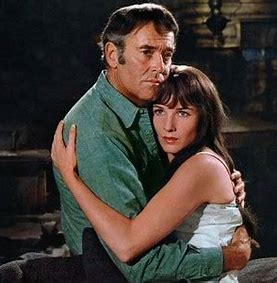

Blue tells the newcomers that Molly is his wife so she can live with him and heal, and not get put to work in the saloon. Except Molly is bitter, wants to leave, is convinced the Man From Bodie is going to return, and calls Blue a coward and not a real man every chance she gets. I'm like, Damn Girl! Give It A Rest! She's like, Do you have any idea what that horrible man did to me? We can only imagine. She doesn't understand Blue, even as she is falling for him. She and Blue then get into a battle for young Jimmy's soul: Molly pushing him to "be a man" and become a gunslinging trigger-happy revenge seeker (it was his pa who was killed), while Blue wants him to become educated, analytical, forgiving and well-grounded. This, I assume, is the crux of the film's message, which is, Does revenge ever achieve justice? How can peace ever be achieved when folks are so embittered that they continue to retaliate for the wrongs done to them? When does "turn the other cheek" become the guiding principle in a lawless world? 

With many of the buildings rebuilt, the fun-seeking miners and the stagecoach come through as usual and for a while, things are popping again in Hard Times. Relationships are cemented. Despite Molly's bitterness, she, Jimmy and Blue have formed a nuclear family. The new tent saloon does well. But then the seasons turn and the townspeople suffer through a hard winter. The mine closes temporarily, threatening all their livelihoods. And then, as soon as things warm up, The Man From Bodie shows up again, terrorizing the town just as he did before. 


Evil Man From Bodie


I couldn't believe my eyes, like the minute he rode into town they should have had Warren Oates, who was supposed to be the new sheriff not to mention a sharpshooter, gun the guy down before he even got off his horse. But they didn't. They let him drink a gallon of liquor, rough up and kill one of the new girls, and burn down the saloon -- AGAIN. When Oates finally goes into action, he mistakenly kills Keenan Wynn, blecch. 

Finally, finally, when The Man From Bodie runs out of bullet, Blue is able to shoot him down. And to shut Molly up, he hauls the dying maniac over to his house and throws him on the table. But then the Maniac opens his eyes, Molly goes for the knife but Maniac grabs her. Young Jimmy blasts him dead with a shotgun but of course catches Molly right in the gut with some buckshot. She's done for. Oh well, hookers always pay for their sins in the movies.  Besides, she was never going to be happy with Blue because of her belief that those sins from her past mark her as no good for love. Oh the irony. Still, the film ends on a semi-promising note, with Blue and young Jimmy surveying what's left of the town from the cemetery hill and imagining a new future. 

This flick was a complete downer and headscratcher. The immediate relief that The Man From Bodie is gone is tempered -- at least in my mind -- by the miserable deaths of all these folks, and the fact that Blue noted mid-picture that the barren lawless landscape of the West seems to breed up these types of violent characters. So there's the specter of another Man From Bodie, or Man From Somewhere, showing up to burn it all down in the future.  It's Sisyphean, an endless purgatory of building up the town only to see it decimated, over and over. 

The film tries to end on an upbeat note, but it's a Pyrrhic victory (what's with me and the Greek references today?).  Seems that many have to die in this atmosphere so just a few can live.  But at what cost?  And yet, doesn't every town and everybody face Hard Times? 


Sunday, February 11, 2018

Love Me Like A Rock: "Phantom Thread"

Phantom Thread
directed by Paul Thomas Anderson
starring Daniel Day-Lewis, Vicky Krieps, Lesley Manville

What to say about Phantom Thread. Hmmmm...

Well, it seems that I have a thing for director Paul Thomas Anderson, because in his films you are not going to get a standard narrative, and I do like being surprised. With his films you are going to get a thought-provoking, confronting, unusual film experience that makes you examine in depth the often-illogical and sometime unpleasant ways that being human asserts itself. Consider The Master, Inherent Vice, Boogie Nights, There Will Be Blood. These films offer unique narratives about the fraught relationships between some extremely complicated -- OK, weird -- people.

On its surface, Phantom Thread is about a successful, meticulous, and insular man and the way in which love disrupts his very ordered life.

Looked at from another angle, the film is about a war of wills between an older man and a very determined young woman who will not be discarded or dismissed. (I was reminded of Glenn Close's plaintive statement from Fatal Attraction some 30 years ago: "I'm not going to be ignored, Dan.")

This is about a grown man with severe, unacknowledged Mommy issues, who strikes an unusual psychological bargain that allows him to crawl, helpless, into the nurturing arms of a strong female from time to time.

At its heart, the film is about what truly shapes a relationship, about the totally unseen and unsuspected reality of reciprocal need and desire that draws two people into a partnership, i.e. the phantom thread sewn through the fabric of two people's lives that stitches them irrevocably together. When this thread is revealed toward the end of the film, we the viewers are aghast. Particularly because the film itself is so mannered, so elegant, so well composed and measured, so politely English, and the bargain struck between the couple at the center of the story seems almost macabre.


The main character, Reynolds Woodcock (played by the marvelous Daniel Day-Lewis), is a highly regarded British couturier who designs and constructs dresses for a fashionable 1950s clientele that includes countesses, princesses, society dames, and the like. Fussy, eccentric, demanding, rich, and wholly self-involved, Reynolds trusts only his sister and business partner, the equally dour and demanding Cyril (a perfect Lesley Manville), whose every move caters to the personal whims and professional needs of her brother. Their business occupies an impeccable and fashionable London townhouse, staffed by a bevy of loyal seamstresses and patternmakers and, on occasion, by Reynolds' lover of the moment, a young woman who is usually fired and ushered out by Cyril.

At an English seaside hotel restaurant, Reynolds acquires a lovely young waitress, Alma (a Mona Lisa-like Vicky Krieps), who becomes new lover and muse. He flatters her, measures her for new gowns, shares his memories of his late mother, who inspired him to sew, and ultimately brings her to the townhouse and installs her as part of the household. Except that Alma, who is feisty, opinionated, and in love, doesn't quite fit into the be-seen-but-not-heard role Reynolds demands. Though he shares with her the secrets of his craft, and the fact that messages or coins can be sewn into the lining of a garment, and learns that Alma truly recognizes the creative sanctity of his work, Reynolds is mostly a cold customer.

After some unpleasant confrontations between the patronizing and wholly selfish Reynolds and a hurt Alma, the young woman decides to take drastic action to get Reynolds to "settle down" and return to a state of vulnerability and tenderness she knows he is capable of, a state in which Reynolds recognizes and affirms his love of Alma. Soon Reynolds becomes ill, and Alma locks everyone else out, including Cyril, to nurse him back to health. After this episode, Reynolds asks Alma to marry him, and Alma accepts.

But within months, Reynolds regrets the marriage, becomes annoyed with everything Alma does, cannot concentrate on work, becomes verbally abusive to Alma, and begs Cyril to help him correct the enormous "mistake" that he's made. Alma, overhearing Reynolds' fitful complaints to his sister, again takes matters into her own hands to get Reynolds to "settle down." It is in the final moments of the film when we learn that Reynolds is not only aware of Alma's plans, but condones them.

The film's story is framed by Alma explaining to a young doctor how and why her relationship with Reynolds continues to work. But the nature of this bargain is beyond the doctor's -- and our -- ability to comprehend.

Should you see it? Sure. If you're a fan of Day-Lewis, great filmmaking, and scratch-your-head endings. But the truth is, more than one relationship has a funky phantom thread running through it. And it should by all means remain hidden from view.


Random Notes:

* The impeccable cinematography and attention to sartorial splendor reminded me in some ways of fashion designer/film director Tom Ford's directorial debut, 2009's A Single Man.

* The film's score -- combining lush composed music by Jonny Greenwood with a mix of classical pieces and period big band melodies -- enhances the overall mood of the piece as something elevated and atmospheric, but also tense and timeless.

* The scenes of industry within Woodcock's townhouse reminded me of a more personal memory, of what it's like to go to work daily in a historic home. The soundscape is very different from working in an office environment, where you often have carpeting, glass, and other expanses of man-made and modern materials, including elevators. I was reminded that as a teenager, in the late 1970s, I worked as a program assistant at New York's International Center of Photography, which was then housed in New York City's historic Willard D. Straight House, a four-story Georgian-style mansion on Fifth Avenue and 94th Street (the museum and school have since moved and expanded to several locations). I was captured by the sounds of the door hinges creaking, the glass door knobs, the ringing of footsteps along the parquet floors, the climbing to various high-ceilinged offices along the grand wooden staircases in a building that had been constructed as the home of a rich New Yorker some 70 years earlier.

* Love and politics make for strange bedfellows.

______________
*all photos screenshots

Saturday, January 6, 2018

Frosty The Snow Flick: Thinking of Some Cold Weather Films


A couple of days ago, we got hit with close to a foot of snow. While I've survived many a cold, snowy winter, it is not my favorite climate. If I get too cold, I cease to function. I've been this way for a while; as soon as I start to feel a chill I start to shut down. The worst episode was when I was a teenager. It was February with snow on the ground and my dad and I were driving back down the I-95 to the Bronx from Boston, where I'd visited some college campuses. The station wagon malfunctioned somehow, and in the days before cellphones, my dad left me in the vehicle on the side of the road while he went for help. Waiting for his return, I developed my first case of frostbite. Seeing my fingers turn from white to purple to black, then feeling the burning, searing pain when the blood finally returned to my extremities is something I have never forgotten.

So when I see films where extreme cold and snow are a factor, I physically recoil. No matter how great the storyline, no matter how temperate my surroundings while watching, I often find myself growing uncomfortable, viewing with my shoulders raised to my ears, arms crossed, hands tucked under, teeth gritted.

Here are three of the frostiest films that I can think of off the top of my head:

The Revenant (2015)
This is an Oscar-winning tale of adventure and revenge in a bitter cold West of 1823, directed by Alejandro G. Iñáritu. Leonardo diCaprio stars as Hugh Glass, a reluctant guide for a ragtag fur-trapping party, whose half Pawnee teen son comes along. The group is attacked by another tribe, and to avoid being ambushed by more natives along their journey, Glass leads them overland to Fort Kiowa. Except on the way he is horribly mauled by a bear. The group's now self-appointed leader, John Reynolds (a weaselly Tom Hardy), attempts to smother him but is caught in the act by Glass' son. Hardy stabs the son to death before Glass' helpless eyes, convinces the rest of the party that Glass is dead, and abandons him to the elements, intent on cashing in the pelts for himself. The film now becomes a grueling survival story, as Glass must endure bitter cold, dense snowfall, bone-chilling rains, ice-laden rivers, further Indian attacks, and hunger, not to mention being debilitated by his wounds, as he attempts to get to Fort Kiowa, then revenge himself on Reynolds. Their final showdown takes place in a vast snowy landscape by a frozen creek. Photographed in grim grays and dim blues, the film' cinematography is awe-inspiring as it depicts the vast and lonely vistas of snow-covered mountains, frosty meadows, and ice-covered waterways. But the film literally left me cold. While DiCaprio's endurance in portraying this long-suffering character is notable, I couldn't wait for The Revenant to be over.

Dr. Zhivago (1965)
This David Lean-directed classic tells the story of the Russian Revolution, as seen through the eyes of an idealistic, aristocratic poet and doctor, and the troubled seamstress' daughter turned nurse with whom he has an affair. It's a long, melodramatic film on a scale as vast as Russia itself, with numerous twists and turns, a score of dynamic characters, incredible setpieces, and a soaring musical score. If you pay attention it offers new and interesting details with every successive viewing. What I most remember is Zhivago fleeing Moscow to a country estate with his wife, son, and in-laws, traveling by train through a barren landscape of endless sacked villages covered in snow, then arriving at the manse in the dead of winter by horse-drawn sleigh. Later in the film, he will take refuge here again with his lover, Lara, after the estate's lower floors have become an ice palace due to destruction by rebel forces and the elements. The cinematography and set designs are amazing and who can forget the Russian style sable and fox furs donned by the romantic pair as they survey the scene? The two almost make the snow seem cozy.

Fargo (1996)
Named for the North Dakota city where some of the film's "malfeasance" takes place, Fargo is the Coen Brothers' tragicomic story about a hapless car salesman so desperate to make a name for himself as the sole owner of a parking lot that he sells his soul -- and that of his unsuspecting wife, the daughter of a rich and controlling local tycoon -- to a pair of violent, ignorant louts. Nothing good can come from a scheme in which Jerry Lundegaard (the incredible William H. Macy) pays to have his own wife kidnaped so he can pocket the ransom and launch his business; everything that can go wrong does go wrong, and hot on his trail is a good-natured, persistent, and very pregnant police officer Marge Gunderson (a crack turn by Frances McDormand) from Minnesota's Twin Cities. Snow and cold figure prominently in the film, as characters must suit up to head out into the elements in snowboots and hats, the long featureless highway between towns is a bleak frozen tundra, a police informant so bundled up as he leans on a snow shovel that he can barely be seen, Steve Buscemi's bad guy packs snow onto his bloody jaw after being shot, then later cluelessly buries an attache case full of cash at an indistinguishable fence post among many along the snow-swept road. At the conclusion Marge chases down acerbic bad guy Peter Stormare across a frozen lake. Cold and snow are an unremarkable part of life in this part of the country. Marge lectures her quarry as she takes him to jail in a squad car traversing the snowdrifts: "There's more to life than a little money, ya know. Don'tcha know that? And here ya are. And it's a beautiful day." (Emphasis mine.)

What are your standout snowy flicks? Feel free to follow this blog and post your comments below.
----------